
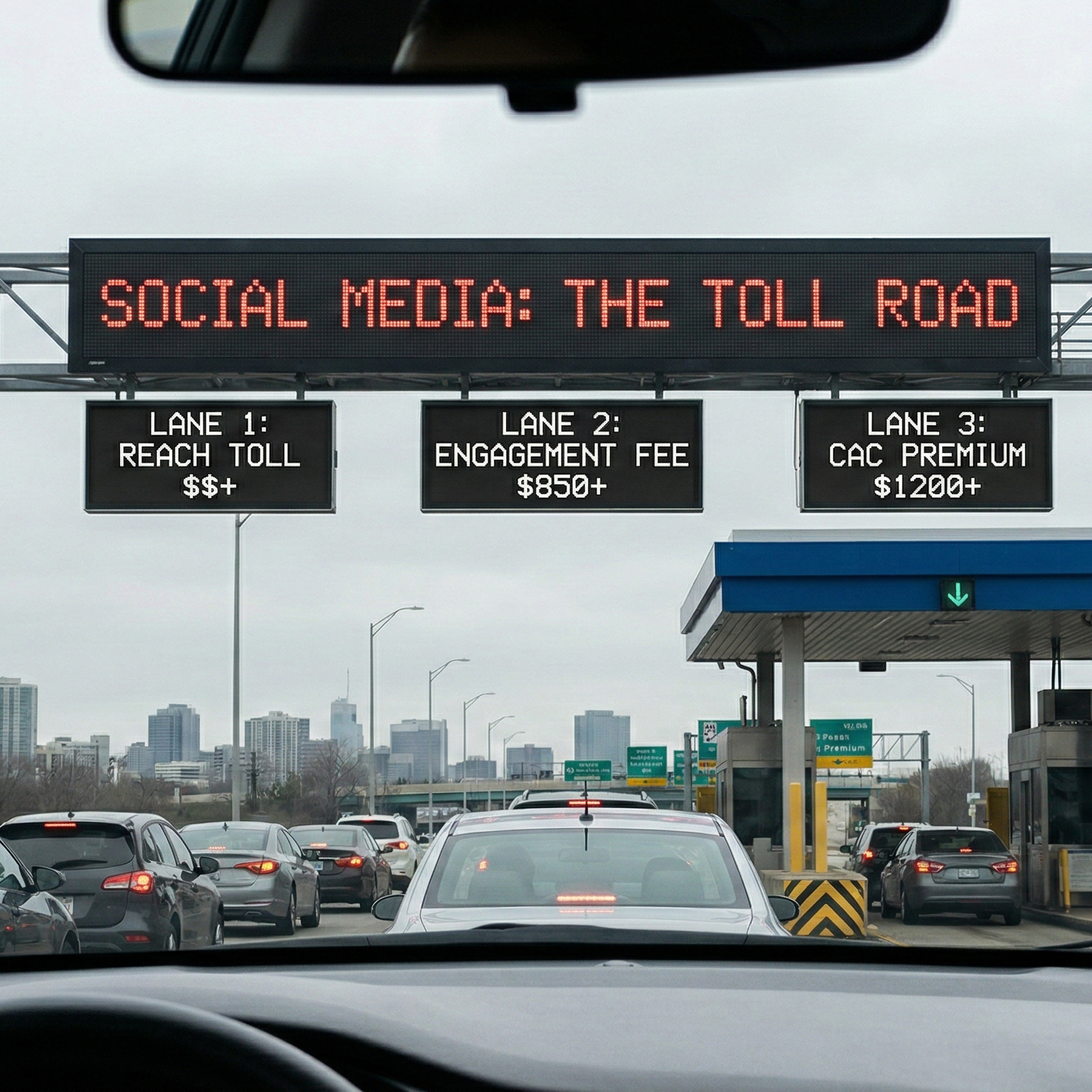
Social media was supposed to be the shortcut. For most brands, it has become something else.
For nearly a decade, the promise was simple: social media was the great equalizer. Small brands could punch above their weight. Awareness was cheap. Reach was democratic. You didn’t need a massive media budget — you needed a good post and a little luck.
That era is over.
What was once a low-cost awareness engine has matured into a high-complexity, high-friction performance channel. The tolls are rising. The traffic is stagnant. And too many brands are still driving the same road, wondering why the destination keeps moving.
The algorithm is not your audience
Here is the tension at the center of modern social marketing: the content that performs best on the platform is not always the content that builds the brand.
Agencies know this. They optimize for what the algorithm rewards — velocity, novelty, engagement rate — because that is how they justify their retainers. The result is a feed full of content designed to be consumed, not remembered. Brands are producing more than ever and compounding less than ever.
The numbers support the skepticism. Engagement rates on Facebook have fallen to 0.15%. The “learning phase” for most paid social systems now requires a baseline spend of $650 to $2,500 before the algorithm has enough data to do anything useful. Customer acquisition costs in high-consideration categories — financial services, professional services, anything requiring trust — have crossed into four figures on social platforms. For those brands, the math rarely works.
The problem is not effort. It is direction.
What consumers actually want
The backlash against performative social is no longer anecdotal. It is structural.
Approximately 63% of consumers report being less likely to choose a brand that uses AI-generated advertising. The “unhinged brand” persona — bold, chaotic, algorithmically engineered to go viral — is now considered overplayed by most industry observers. More than half of adults say there are too many influencers online. Bot fraud costs brands an estimated $1.3 billion annually.
And underneath all of it: 50% of consumers say the most important thing a brand can do is simply be honest.
Not clever. Not viral. Honest.
This is not a trend. It is a correction. Consumers spent a decade being marketed at through a screen, and they have developed extraordinary tolerance for filtering it out. The brands that are breaking through are the ones investing in moments that cannot be manufactured — real experiences, real community, real trust.
Where the smart money is moving
Retail media now represents 22% of marketing budgets, up from 15% just three years ago. Brands that partner with trusted retailers — rather than fighting for attention in a crowded feed — benefit from borrowed credibility and higher-intent audiences. The ROI is measurable in ways that social rarely is.
Experiential marketing is no longer a nice-to-have. Global spend in the sector is approaching $130 billion. 85% of consumers report higher purchase intent after participating in a live brand experience. 77% report increased trust. And 91% share their experiences on social — creating the organic amplification that paid social increasingly fails to deliver.
Owned media is having a quiet renaissance. Email lists. Newsletters. Private communities. Brands that move their audiences off rented platforms and into owned channels are building something that no algorithm change can take away.
Lush Cosmetics left major social platforms in 2021. By 2025, they had 3 million opted-in newsletter subscribers, a thriving app, and proof that a brand can grow without feeding the machine. It is not a strategy for everyone. But it is a signal worth paying attention to.
The strategic question
None of this means social media is irrelevant. For impulse categories — low-friction, visually driven, e-commerce-native — it remains a legitimate growth channel. The funnel is shorter, the purchase is faster, and the platform mechanics work in the brand’s favor.
But for brands selling anything that requires consideration, trust, or relationship — the calculus is different. Social can serve as a discovery layer. It should not be the foundation.
The brands pulling ahead in 2026 are the ones asking a harder question: are we building equity, or are we renting attention?
Renting is faster. Building lasts.
At Gambit, we help brands answer that question, and build the strategic foundation that makes the answer actionable. If your marketing feels like it’s working harder than it’s compounding, that’s usually a strategy problem, not an execution one.