The cost of looking like a brand just fell to zero. That is a bigger problem than it sounds.
A founder with a laptop can build a brand in an afternoon. Logo, color palette, a voice, a launch campaign, a full visual identity, for roughly the price of a coffee. Ten years ago that took a studio, a few months, and a real budget. Today it is close to free. That sounds like good news. For most brands, it is quietly becoming the opposite.
When everyone looks polished, polish stops meaning anything
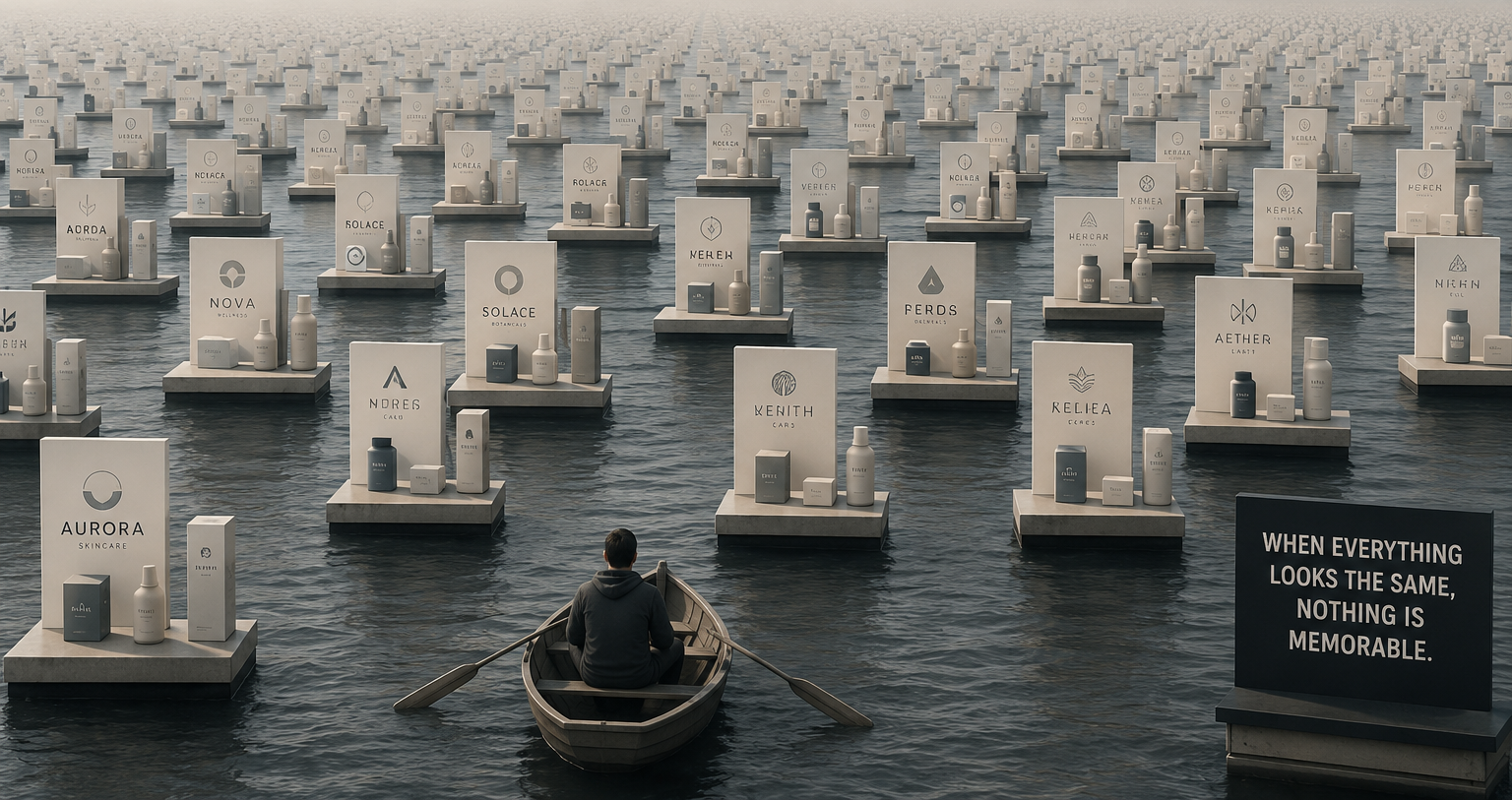
Scroll any category right now and watch what happens. The brands blur together. The same clean sans-serif. The same soft gradient. The same founder story told in the same friendly cadence. The same tasteful palette that signals “we are a modern brand” and nothing else. Everything is competent. Everything is attractive. Almost nothing is distinct.
This is not a coincidence, and it is not a passing trend. It is the new default. The tools that made looking like a brand cheap also made looking like a brand generic. When the cost of polish drops to zero, polish stops being a signal. It becomes the wallpaper everyone is standing in front of. Sameness used to be a risk you could avoid with effort. Now it is the natural resting state of the market. Do nothing distinctive, and the current pulls you into the blur automatically.
You cannot out-produce sameness
The instinct, when a brand feels invisible, is to make more. More posts, more campaigns, more content, faster, across more channels. The tools are right there, and they are happy to help.
But volume is not the answer to sameness, it is the accelerant. More of a generic thing is just more generic. You do not escape the blur by producing at the speed of everyone else producing the same blur, you add to it. The brands drowning in the feed are not drowning because they made too little, many of them are drowning because they made a great deal of work that could have belonged to anyone.
Producing more solves nothing if the thing you are producing more of has no point of view underneath it.
The one thing the tools cannot generate
Here is what has actually changed. The tools can now execute almost anything, but what they can’t do is decide what is worth executing.
They can generate a voice. They can’t tell you what your brand believes. They can produce a thousand on-brand assets. They can’t tell you what “on-brand” means in the first place. They can give you infinite options. They can’t give you conviction about which one is true.
A point of view is the one input that has to come from somewhere else. A real definition of what a brand stands for, specific enough that everything built on top of it holds together, and that definition is now the scarce asset. It is the thing the market is short on, precisely because it is the one thing the tools can’t hand you.
And it is what turns all that cheap production from a liability into an advantage. A sharp definition is what makes a thousand generated assets feel like one brand instead of noise. Without it, the tools just help you make sameness faster. With it, the same tools become a multiplier. So the arrival of all this capability did not make strategy less important. It made strategy the only thing that still separates one brand from the next.
The choice has sharpened
Every brand now faces a cleaner version of an old decision. Define yourself with conviction or get absorbed into the blur, there is no neutral option. An undefined brand does not sit quietly in the middle, waiting, it dissolves into the category around it, and the market is perfectly willing to define you in your absence. Its default answer is generic, and it applies that answer the moment you fail to supply your own.
Definition, in other words, has stopped being a brand exercise you get to the next time there is budget, it’s the thing that decides whether a brand is seen at all.
Make the decision yours
This is the work worth doing now. Not making more. Making a brand mean something specific, then making that meaning hold everywhere the brand shows up, so the cheap, fast, abundant production finally has something true to be built on. The decision about what your brand stands for is the one decision worth protecting from the default. The market will make it for you if you let it. The better move is to make it first, and make it yours.
Gambit is a senior-led brand strategy practice. We give brands a definition sharp enough to survive the noise, then make sure it holds everywhere the brand shows up.